
Everything You Need to Know About Joro Spiders in Locust Grove
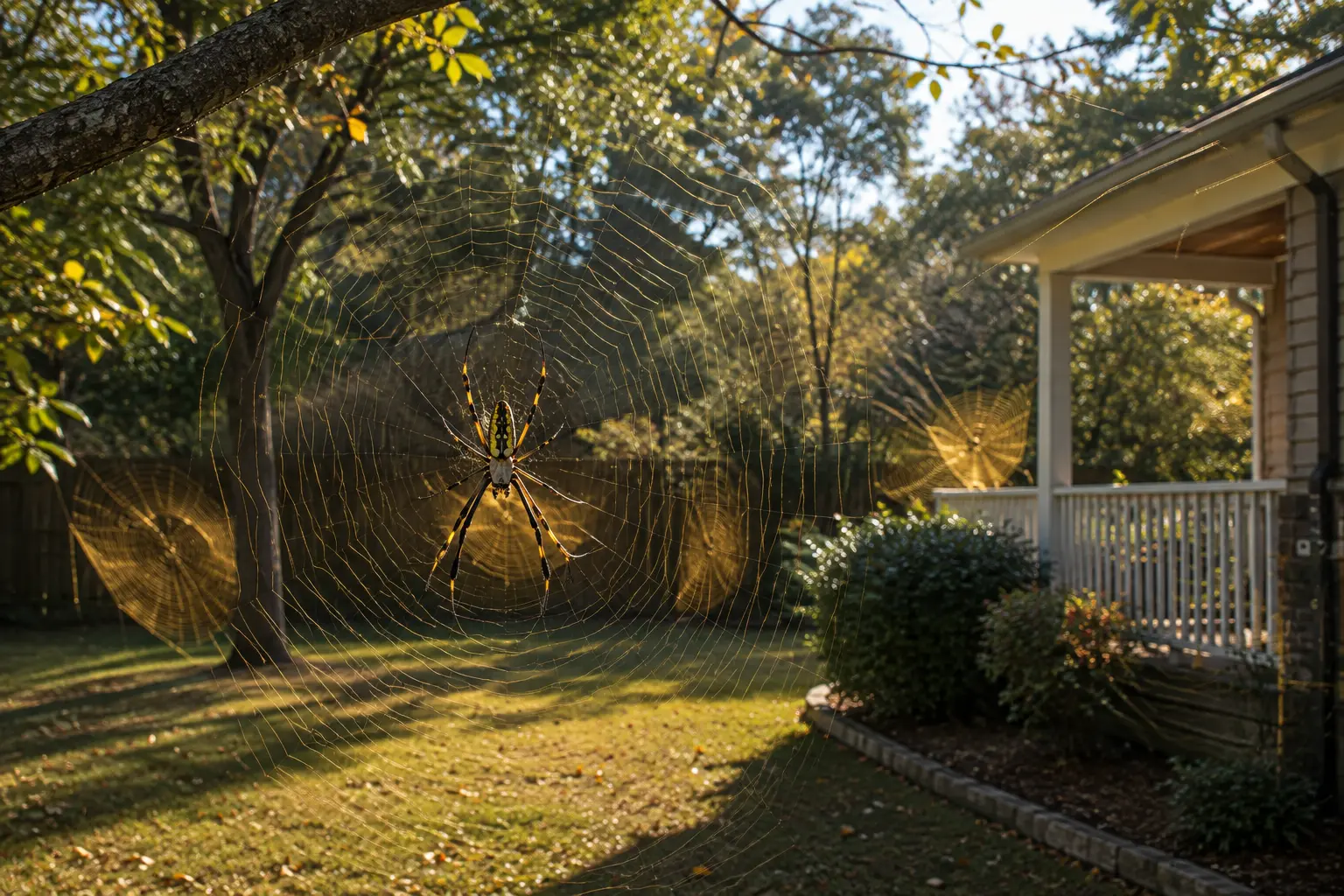
If you have spent enough time outside in Locust Grove between late summer and fall, chances are you have had a moment with a Joro spider. Maybe you walked straight into a web. Maybe you noticed one hanging above the porch. Or maybe you spotted the spider first and wondered how something that large ended up in your yard.
Joro spiders have become a familiar sight around Georgia, but there is more to them than their size and those hard-to-miss webs. How long do they live? Do they actually bite? Why are their webs so large, and what brings them so close to homes? We are breaking down what Locust Grove homeowners should know before the next Joro shows up.
If Joro spiders are becoming a regular nuisance around your Locust Grove property, Direct Pest Solutions can help get the problem under control. We can inspect the areas where you are seeing activity and provide targeted Joro spider control to help keep the problem from taking over your property.
What Are Joro Spiders?
The Joro spider, or Trichonephila clavata, is a type of golden orb-weaver native to East Asia. It is found naturally in places such as Japan, China, Korea, and Taiwan. Joro spiders were first documented in Georgia in the early 2010s, with confirmed identification in the state in 2014.
Since then, they have become a familiar sight across parts of Georgia. They are especially easy to notice once the spiders mature because the females are large and brightly colored, while their webs can stretch several feet between trees and other structures.
Despite their intimidating appearance, Joros are generally timid. When disturbed, they typically try to get away rather than confront people.
What Do Joro Spiders Look Like?
Adult female Joro spiders are the ones most people notice. Their bodies have bright yellow coloring with bluish-green bands, red markings underneath, and long black legs marked with yellow. Their bodies can exceed an inch in length, while their legs can extend several inches.
The males look surprisingly different. They are much smaller, thinner, and mostly brown, yellow, and black. In fact, you might see a male near a female and not realize they are the same species.
Young Joros are also harder to identify because they start out much smaller and less colorful. Their adult colors become more noticeable as they mature through the summer.
How Big Do Joro Spiders Get?
The female Joro spider can have a leg span of roughly 3 to 4 inches, which is why one sitting in the middle of a web can look enormous compared with the small spiders most people are used to seeing around the house.
That size also changes how noticeable they are. A small spider can disappear into a garden or shrub without much attention. A brightly colored spider with several inches of leg span sitting in a large golden web is much harder to miss.
Why Are Joro Spiders So Noticeable in Locust Grove?
Part of it is their size. Part of it is the web. They also become much easier to spot at the same time of year when people spend plenty of time outdoors.
Joros grow throughout the warmer months and become particularly noticeable as they reach adulthood in late summer and early fall. Their mature webs are also larger and more distinctive than the silk produced by younger spiders.
When Are Joro Spiders Most Active?
Joro spiders spend the warmer part of the year growing. By late summer, females have developed their recognizable colors and larger bodies, and adults become much easier to spot.
UGA Extension notes that females are easily recognizable by around mid-August and that adults mature around August and September. They reproduce in the fall, after which the adults eventually die as colder weather arrives.
That is why you may suddenly feel like Joro spiders are everywhere when fall approaches. They have not necessarily appeared overnight. They have simply reached the stage of their life cycle when they are much harder to overlook.
What Does a Joro Spider Web Look Like?
The web may be the first thing you notice. Mature female Joros create large, three-dimensional webs made from thick, strong silk. When the sunlight catches the strands, the silk can have a noticeable golden or yellow appearance.
Unlike a simple flat web tucked into a corner, a Joro web can look more like a large structure suspended between several points. Supporting strands can stretch between trees, porch columns, fences, and other sturdy surfaces.
How Big Are Joro Spider Webs?
Joro spider web size is one of the reasons these spiders get so much attention. Mature webs can span 10 feet or more, while supporting strands can extend 20 feet or longer between structures such as trees.
That does not mean every Joro web in your yard will be 10 feet wide. The size depends on the spider’s age and the space available for it to build. But when you see silk stretching across a surprisingly large gap between trees, a porch, or another structure, a Joro spider may be responsible.
Why Do Joro Spiders Build Such Large Webs?
The web is where the spider hunts. Flying insects become trapped in the sticky silk, giving the Joro an opportunity to capture and eat them.
A larger web gives the spider more space to intercept passing insects. The supporting strands also allow the spider to build across open areas instead of keeping the web tucked into a small corner.
Where Do Joro Spiders Build Their Webs?
Joros need places where they can anchor their silk, so their webs often appear where there are plenty of elevated support points.
You may find them:
- Between trees
- Across shrubs and vegetation
- Along fences
- Around porch columns and decks
- Near eaves and other parts of a home
- Around utility lines and poles
- Between outdoor structures
- Along walkways and other open areas
Mature Joros tend to build higher off the ground, which is one reason their webs can suddenly appear across spaces you normally walk underneath.
What Do Joro Spiders Eat?
Joro spiders are predators, so the web is essentially a waiting station for their next meal. They catch flying insects that become stuck in the sticky silk and then feed on them.
Their diet can include a wide variety of insects. UGA sources have specifically noted Joros feeding on brown marmorated stink bugs, among other prey.
That does not mean you should encourage a large spider population around your home. It simply explains why Joros tend to settle in areas where there is plenty of insect activity and enough space to build a web.
How Long Do Joro Spiders Live?
Joro spiders have a one-year life cycle. The adults you see in late summer and fall are part of the same generation that began as eggs the previous year.
Female Joros lay egg masses in the fall, and the eggs remain protected through winter. The eggs hatch in spring, with young spiders growing through the warmer months before reaching adulthood later in the year.
So the large spider you see in September did not spend several years growing in your backyard. It developed over the course of one season.
When Do Joro Spiders Lay Eggs?
Female Joro spiders reproduce in the fall. They create silk-covered egg masses containing hundreds of eggs, which they attach to protected surfaces such as leaves, bark, or structures.
UGA Extension reports that egg masses can contain several hundred eggs and, in some cases, more than 1,000.
After reproduction, the adult spiders eventually die as temperatures drop.
What Happens to Joro Spiders in Winter?
The adult spiders do not survive indefinitely through the winter. The next generation does.
The eggs remain in their protective silk masses during the colder months. When spring arrives and temperatures rise, the young spiders hatch and begin the next cycle.
This is why knocking down a few adult spiders in the fall does not mean Joros will disappear from the area permanently.
When Do Baby Joro Spiders Appear?
Joro eggs generally hatch during April and May. The young spiders are much smaller and less colorful than the adults you see later in the year.
They spend the spring and summer feeding, growing, and developing their adult appearance. By late summer, the females become much easier to recognize.
Are Joro Spiders Dangerous?
For most people, encountering a Joro spider is more startling than dangerous. These spiders are not known for being aggressive toward people, and their typical response to disturbance is to retreat.
UGA Extension describes Joros as very timid and notes that they generally try to get away when disturbed.
That said, Joros are still spiders with venom used to subdue their prey. It is sensible to avoid handling one, especially when you can simply leave it alone or use a tool to move it away from a frequently used area.
Why Are Joro Spiders Found Around Homes in Locust Grove?
Joro spiders are not particularly interested in your house itself. They are interested in what the area around it provides: places to anchor a web and insects to catch.
A property with mature trees, dense vegetation, fences, outdoor structures, and plenty of nighttime insect activity can give them several good places to settle.
Outdoor lighting can also attract flying insects, which may indirectly make an area more appealing to spiders looking for food. Keeping vegetation maintained and reducing unnecessary lighting around outdoor areas can help make those spaces less attractive to insects.
What Should You Do If You Find Joro Spiders on Your Property?
The right response depends on where the spider is and how much of a problem it is creating.
If you find one in an out-of-the-way part of the yard, leaving it alone may be the easiest option. If a web is blocking your walkway or covering a porch, physical removal can make more sense.
You can also:
- Remove webs from frequently used areas with a broom or long-handled tool.
- Keep vegetation trimmed around the home.
- Clear webs from porches, decks, fences, and walkways regularly.
- Reduce unnecessary outdoor lighting that attracts flying insects.
- Avoid reaching into large webs or trying to handle the spider directly.
- Consider professional help if spider activity becomes widespread or difficult to manage.
Simply destroying a web does not guarantee that the spider will disappear. UGA Extension notes that Joros can rebuild webs, which is why repeated activity may require a different approach.
When Should You Call a Pest Control Professional?
Seeing a Joro spider in your yard does not automatically mean you need pest control. But repeated activity can become a different story when the spiders start taking over the spaces you actually use.
Professional help may make sense if:
- Large webs keep appearing around your home.
- Spiders are building webs across porches, entrances, or walkways.
- Webs are too high or difficult to remove safely.
- You are finding repeated spider activity around the property.
- You are unsure if the spider you found is actually a Joro.
- DIY removal is becoming a constant chore.
A professional pest control team can inspect the property, identify areas where spiders are repeatedly building webs, and address the conditions contributing to the activity.
Dealing With Joro Spiders in Your Home in Locust Grove?
Joro spiders are likely to remain a familiar part of Georgia’s landscape, so seeing one does not necessarily mean there is a serious pest problem. The situation is different when large webs keep appearing around the areas you use every day.
Direct Pest Solutions can inspect your Locust Grove property, identify areas of repeated spider activity, and recommend an appropriate control approach. If Joro webs have become a regular nuisance around your home, request a free quote or call (678) 722-5533 to schedule an inspection.
Frequently Asked Questions
Why are Joro spiders so big in Locust Grove, GA?
Locust Grove’s long, warm growing season gives Joro spiders plenty of time to feed and mature. By late summer and fall, female Joro spiders have reached their adult size, making both the spiders and their large webs much easier to notice.
Do Joro Spiders Bite?
Yes, Joro spiders can bite, but they rarely have a reason to do so. They usually retreat when disturbed rather than confront people. Avoid handling or provoking them, and use a broom or long-handled tool if you need to clear a web.
Are Joro Spider Bites Harmful?
Joro spider bites are not generally considered dangerous to people. A bite may cause local redness, swelling, or pain. If you experience a severe or unusual reaction, seek medical attention.
How to get rid of Joro spiders?
If a Joro spider is in an inconvenient outdoor location, you can carefully remove it and its web with a broom or other long-handled tool. If you are finding spiders and webs throughout the property or in areas that are difficult to reach, professional pest control can help determine the appropriate way to address the activity.
Do Joro spiders come back every year?
Yes. Individual adult spiders do not live for several years, but a new generation appears each year. Eggs survive the winter, hatch in spring, and develop into adults that reproduce later in the year.
Can Joro spiders get inside your house?
They are primarily outdoor spiders, but an individual Joro can end up near or inside a home. If you repeatedly find spiders indoors, it is worth checking nearby entry points and the outdoor conditions that may be attracting spider activity.
Should you kill Joro spiders?
Not necessarily. If a Joro is in an out-of-the-way part of your property, leaving it alone may be the simplest option. If its web is blocking a walkway, covering a porch, or creating another nuisance, removing the web or relocating the spider can be more practical. For repeated activity, professional pest control can help you determine the best way to manage it.
How quickly can a technician come to inspect my home in Locust Grove?
Once you schedule an appointment, a technician will come to your property to inspect the problem and determine the right treatment. You can request a free quote online from Direct Pest Solutions or call (678) 722-5533 to schedule.