
How to Spot Joro Spider Webs and Remove Them in McDonough
By late summer in McDonough, Joro spider webs can start showing up in places you would rather not find them. A web across the walkway, between the trees, or beside the porch can quickly turn into an everyday annoyance, especially when you keep clearing it only to find another one a few days later.
Joro webs are distinctive once you know what to look for. Their unusual size, golden silk, and layered structure are some of the easiest clues, while the location can tell you more about where the spider is active. We will break down these features below, along with how to remove Joro spider webs and what to do when they keep appearing.
If Joro spiders are becoming a regular problem around your McDonough property, Direct Pest Solutions can help. We can inspect the areas where you are seeing activity, find out what is attracting spiders to the property, and recommend practical Joro spider control steps to help keep the webs under control.
Meet the Spider Behind Those Giant Webs
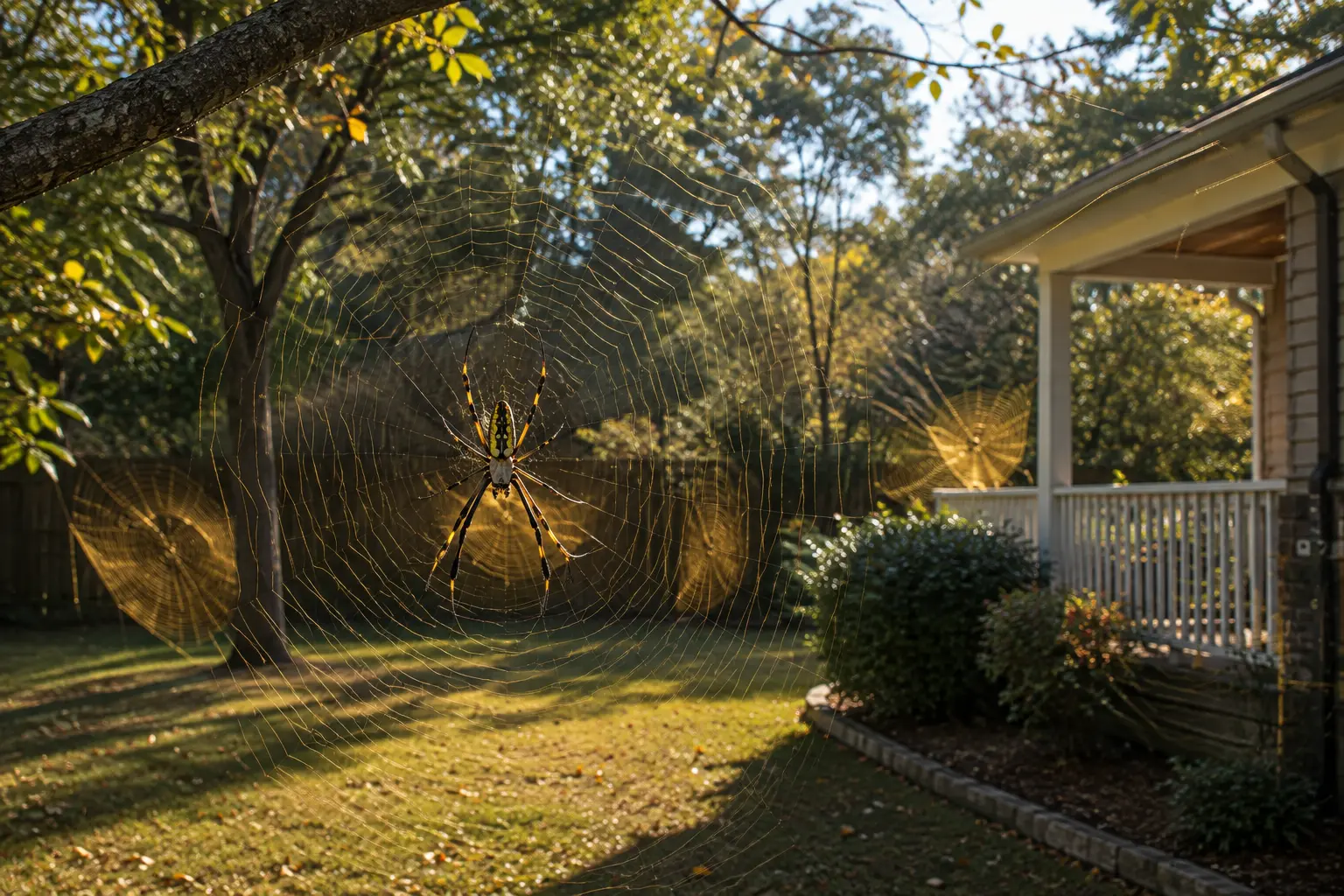
Joro spiders are large orb-weaving spiders originally from East Asia. They were first documented in Georgia in the early 2010s and have since become a familiar sight in parts of the state. Female Joro spiders are especially noticeable because of their bright yellow, black, and red coloring and long legs, with a leg span that can reach around 3 to 4 inches.
Their size is only half the reason people notice them. Joros build enormous, strong webs that often sit higher off the ground than many other spider webs, and they tend to become much easier to spot toward late summer and fall as the spiders mature. They are generally timid and spend much of their time waiting for insects to get caught in the web rather than looking for trouble with people.
How Do You Spot These Joro Spider Webs?
The spider may be hiding somewhere on the web, but you do not necessarily need to see it to know you have found something unusual. Joro webs have a few features that make them stand out, especially once you know what to look for.
The Web Is Large and Hard to Miss
Joro spider web size can be surprisingly large. UGA notes that some can span 10 feet or more, with supporting strands stretching even farther between trees and other structures. That is a lot of webs for one spider, which explains why you may suddenly notice what looks like a giant silk net hanging across your yard.
The web may stretch between tree branches, across a walkway, or from a tree toward a porch or other structure. Its size is one of the easiest clues that you may be looking at a Joro web rather than an ordinary garden spider web.
Look for the Golden Silk
Take a closer look when the sunlight hits the web. Joro spider silk can have a noticeable golden or yellowish appearance, especially when the web is stretched across an open area and catches the light.
That golden color is one of the reasons Joro spiders are often called golden orb-weavers. Their silk is also unusually strong and sticky, which helps the web hold larger prey than many smaller spider webs.
It Is More Than One Layer
A Joro web is not always a simple, flat circle. These spiders create large, three-dimensional, multi-layered webs with strands running in different directions.
This can make the web look almost messy or tangled when you see it from the side. Look closely and you may notice several sheets or layers of silk surrounding the main orb-shaped portion of the web.
Where Joros Like to Build Their Webs
Joro spiders usually build their webs in places where they can stretch the silk between two or more solid points. That can include:
- Trees and shrubs
- Fences and fence posts
- Porches and decks
- Eaves and other parts of a home
- Utility poles and lines
- Between trees
- Around outdoor structures
- Along walkways and entry areas
They often prefer elevated locations, so check above head height when looking for them. Joro webs are also common in wooded and residential areas, where trees and structures give the spiders plenty of places to anchor their silk.
Why Joro Spiders Build Such Big Webs
The web is essentially the spider’s hunting ground. Joro spiders sit in or near the web and wait for flying insects to become trapped in the sticky silk. They can feed on a wide range of insects, including stink bugs and other pests.
The large size and strength of the web give the spider more room to catch prey. So when you see one stretching across your yard, you are looking at more than a random collection of silk. It is an active hunting setup.
Why the Web Keeps Coming Back
You knock one web down on Monday, and by Wednesday another one has appeared in almost the same area. Sound familiar?
Removing one web does not necessarily mean the spider activity is over. If Joro spiders are still active nearby and the area provides good anchor points and plenty of insects, they may continue building. Consistently removing webs can disrupt their activity and encourage them to build elsewhere.
How to Physically Remove Joro Spider Webs
If the main problem is a web across your porch, walkway, fence, or another outdoor area, you may not need to reach for insecticide right away. Start with simple physical removal.
- Knock down visible webs: Use a broom, rake, or long-handled duster to remove webs from accessible areas.
- Check nearby structures: Look around trees, shrubs, fences, eaves, and other elevated areas for additional webs.
- Remove webs regularly: If new webs keep appearing, continue clearing them as you find them. This can disrupt the spider’s preferred location.
- Trim vegetation near the home: Keep branches and dense vegetation from creating easy bridges between trees and your house.
- Reduce outdoor insect activity: Joro spiders feed on insects, so reducing unnecessary outdoor lighting and other conditions that attract flying insects may make an area less appealing.
- Keep outdoor areas maintained: Regularly clear webs from porches, walkways, decks, and other spaces your family uses.
Before You Reach for the Spray
Seeing a giant web can make you want to grab the strongest spray you can find. But spraying every web you see may not be necessary.
Joro spiders are generally timid and are not considered a major threat to people. If the spider is outside and the web is simply in an inconvenient location, physically removing the web may be enough.
Broad outdoor spraying also comes with another issue: you may kill insects and other organisms that were never part of the problem. UGA Extension has cautioned against area-wide sprays and fogging because they can affect other insects rather than targeting Joro spiders alone.
DIY removal also becomes less practical when webs are high above the ground, spread across multiple areas, or keep returning despite regular removal. At that point, it may make more sense to have the property inspected instead of repeatedly treating the same areas yourself.
When the Webs Become Too Much to Handle
Sometimes the web is not the only thing bothering you. You may be finding Joro spiders around your porch every day, seeing webs across several parts of the property, or dealing with webs in places that are difficult or unsafe to reach.
A professional pest control team can inspect the areas where spider activity is concentrated and look at the conditions around your property that may be supporting that activity. This can be especially useful when the problem keeps returning and simple web removal is no longer enough.
Professional help may be worth considering if:
- Joro webs are appearing throughout the property
- Spiders are building webs around frequently used areas
- Webs are too high or difficult to remove safely
- You keep finding new webs after removing old ones
- You are unsure whether the spider is actually a Joro spider
- Spider activity is becoming difficult to manage on your own
Tired of Finding Joro Webs Around Your Home?
One giant Joro web is easy enough to knock down. The frustration starts when you keep finding another one across the porch, between the trees, or right along the path you use every morning. If spider activity has become a regular problem around your McDonough property, you do not have to keep dealing with it yourself.
Direct Pest Solutions can inspect your property, identify areas of spider activity, and recommend the appropriate pest control approach. Our team can also help you address conditions around the property that may be contributing to repeated spider activity.
Seeing large golden webs around your home? Request a free quote or call (678) 722-5533 to schedule an inspection.
Frequently Asked Questions
Why are Joro spiders so big in McDonough, GA?
McDonough’s long, warm growing season gives Joro spiders plenty of time to feed and mature. By late summer and fall, female Joro spiders have reached their adult size, making both the spiders and their large webs much easier to notice.
How to get rid of Joro spiders?
If a Joro spider is in an inconvenient outdoor location, you can carefully remove it and its web with a broom or other long-handled tool. If you are finding spiders and webs throughout the property or in areas that are difficult to reach, professional pest control can help determine the appropriate way to address the activity.
What kills Joro spiders in McDonough?
Insecticides labeled for spider control can kill Joro spiders on contact, but spraying is not always necessary for a single outdoor spider or web. Physical removal can be enough for webs in accessible areas, while repeated or widespread activity may require a professional assessment.
How strong is a Joro spider web?
Joro spider webs are exceptionally strong and sticky compared with many other spider webs. Their large, multi-layered webs can span 10 feet or more, with supporting strands that may stretch much farther between trees and other structures.
What animal kills Joro spiders?
Joro spiders are preyed on by animals such as birds and insects, including mud dauber wasps. Their natural predators can help keep some Joro spider populations in check, although they are not a reliable way to control spider activity around a home.
Do Joro spiders come back every year?
Yes. Adult Joro spiders die after reproducing in the fall, but their eggs remain protected through the winter and hatch when temperatures rise in spring. The young spiders then grow through the summer, with adults becoming much more noticeable later in the year.
Should you kill Joro spiders?
Joro spiders are generally not considered a major threat to people, but their large webs can become a nuisance around homes. If they are covering porches, walkways, entryways, or other areas you regularly use, removing the webs and spiders from those areas can make the space easier to use.
How quickly can a technician come to inspect my home in McDonough?
Inspection availability depends on the appointment schedule. You can request a free quote online or call (678) 722-5533 to schedule an inspection with Direct Pest Solutions.